
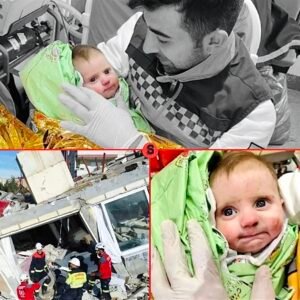
In the aftermath of the devastating earthquake that struck Turkey in February 2023, rescuers faced scenes of unimaginable destruction. Entire buildings had collapsed, families were separated, and thousands of people were trapped beneath tons of concrete and debris.
Among the most heartbreaking searches was the effort to find survivors who had been buried for days. As the hours passed, hope began to fade. After five days without food, water, warmth, or access to fresh air, survival seemed almost impossible—especially for a newborn baby.
Then, after 128 hours beneath the rubble, rescuers heard signs of life.
In the devastated city of Antakya, rescue teams carefully worked through layers of broken concrete and twisted debris. What they eventually discovered seemed almost unbelievable: a tiny baby was still alive beneath the ruins.
The infant had spent days surrounded by darkness, cold, dust, and debris. With no way to escape and extremely limited access to food or water, his survival was nothing short of extraordinary.
For a baby, the situation was particularly dangerous. Newborns have very limited energy reserves and are more vulnerable to extreme cold and dehydration. Their bodies also have difficulty regulating temperature compared with adults. Every additional hour trapped beneath the rubble could have reduced the chances of survival.
Yet somehow, the little baby held on.
When rescuers finally brought him into the open air, the moment became one of the most emotional scenes of the disaster. After nearly five and a half days buried beneath a collapsed building, the child was alive and could be taken for medical attention.
For people who had spent days surrounded by death and destruction, the rescue provided something they desperately needed: hope.
The earthquake had taken away homes, families, and entire communities, but the discovery of a living child after 128 hours reminded everyone that rescue efforts could still produce miracles. It showed why rescuers continued searching even when the odds appeared overwhelmingly against them.
The baby’s survival was not simply another rescue. It became a powerful symbol of human endurance—the extraordinary ability of life to persist even in conditions where survival seems almost impossible.
Beneath tons of concrete, in complete darkness and silence, a tiny life had continued to hold on.
And after 128 long hours, the world finally heard his story.