
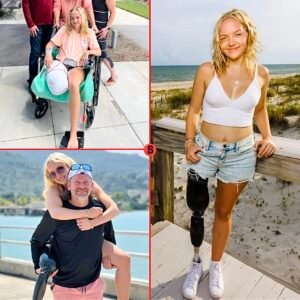
For 17-year-old Addison Bethea, what began as an ordinary day in the waters off Keaton Beach, Florida, suddenly turned into a fight for survival. Addison was scalloping with her family in relatively shallow water when she felt a powerful tug on her right leg. At first, she thought it might have been her brother playing around. But when she looked down, she realized something terrifying: a large shark had bitten her.
The shark, estimated to be around 9 feet (about 2.7 meters) long, had clamped onto Addison’s leg. She desperately tried to defend herself, remembering advice she had heard about fighting back against a shark. She attempted to punch it and push it away, but the position of the animal made it almost impossible for her to reach its nose.
The situation quickly became critical. Addison suffered devastating injuries to her upper right leg, including severe damage to muscles, nerves and blood vessels. The attack caused massive blood loss, and every second mattered.
Fortunately, Addison’s brother, Rhett Willingham, was nearby. Rhett was a firefighter and emergency medical technician, and when he heard his sister screaming, he immediately rushed toward her. He saw the shark attacking Addison and jumped into the water to help.
Rhett fought desperately to separate his sister from the animal. He grabbed Addison and pushed and kicked at the shark until it finally released her. A nearby boater also came to their aid, helping them get Addison onto a boat. Rhett then used his emergency medical training to apply a tourniquet to her injured leg in an effort to control the bleeding and keep her alive.
The rescue did not end there. Addison was rushed back to shore and then transported by helicopter to Tallahassee Memorial HealthCare. Doctors immediately began treating her life-threatening injuries.
Medical teams initially worked to restore blood flow to her severely damaged leg. They were able to preserve some of the tissue in her lower leg, but the injuries to her upper leg were too severe. After multiple surgeries, doctors ultimately had to amputate her right leg above the knee.
For Addison, the physical recovery was only the beginning. She spent weeks in the hospital and later went through rehabilitation, learning how to adapt to life as an amputee. She had to face an entirely different future at an age when most teenagers are simply thinking about school, friends and their dreams.
Yet Addison refused to let the attack define her.
Throughout her recovery, she maintained a remarkably positive attitude. Rather than allowing fear to control her life, she focused on the things she could still do and the future ahead of her. Her family also remained by her side, supporting her through surgeries, rehabilitation and the emotional challenges that came with losing her leg.
Eventually, Addison received a prosthetic leg, giving her the opportunity to regain mobility and begin rebuilding her independence. Her journey became an inspiring example of resilience—not because the tragedy was forgotten, but because she chose to keep moving forward despite everything that had happened.
Remarkably, Addison’s love for the ocean did not disappear after the attack. In the aftermath, she spoke about not allowing fear to take away the things she loved. About a year after the attack, she even returned to the water, showing just how far she had come since the terrifying day that nearly took her life.
Addison’s story is ultimately about much more than a shark attack. It is a story of survival, family, courage and determination. Her brother’s quick actions helped save her life, doctors fought to preserve as much of her leg as possible, and Addison herself faced the long road of recovery with extraordinary strength.
She lost a leg—but she refused to lose her hope, her independence or her love for life.
Her journey is a powerful reminder that sometimes, surviving a tragedy is only the first step. The real victory comes from finding the courage to stand up again—sometimes with the help of a prosthetic—and continue moving forward.