
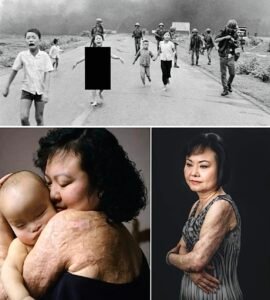
On June 8, 1972, a nine-year-old Vietnamese girl named Kim Phúc became the unforgettable face of the Vietnam War—not because she chose to be, but because a single photograph captured one of the most heartbreaking moments of her childhood.
That day, Kim was near the village of Trảng Bàng in South Vietnam with her family when napalm was dropped on the area. In an instant, the peaceful surroundings turned into chaos.
Flames spread across the village. People ran desperately to escape the burning landscape.
Kim was badly burned.
Her clothes had caught fire, and in terror and pain, she ran down the road crying, “Too hot… too hot…” 💔
At that exact moment, Associated Press photographer Nick Ut was nearby. He captured the now-famous photograph of Kim running down the road, her arms stretched out as she fled the flames.
But Nick Ut did more than take the photograph.
Realizing how seriously Kim was injured, he helped get her to medical care. Doctors initially feared that the little girl might not survive her injuries.
But Kim refused to give up.
She spent approximately 14 months in the hospital and underwent numerous painful treatments and surgeries. Over the years, she would undergo many more procedures to deal with the physical consequences of the burns.
Her recovery was long and incredibly difficult.
Yet the physical pain was only one part of what Kim had to endure.
As she grew older, the photograph that had captured her suffering became famous around the world. Millions of people saw her face without knowing the little girl behind the image.
Kim’s childhood and education were repeatedly disrupted. She was often treated as a symbol of the war and was placed in front of journalists and visitors.
Instead of being allowed to simply grow up and live an ordinary life, she found herself constantly connected to the worst moment of her childhood.
She later described the feeling of being trapped by an image that she had never chosen.
For years, Kim struggled with anger, pain, and the question of why such a terrible thing had happened to her.
But eventually, something inside her changed.
Kim began searching for a way to move forward—not by forgetting what happened, but by refusing to allow the tragedy to control the rest of her life.
In 1992, while traveling with her husband, Kim asked for political asylum in Canada. The decision opened the door to a new chapter of her life.
Away from the war that had defined her childhood, she began building a quieter future.
She married, raised a family, and dedicated much of her life to promoting peace and helping others affected by war.
Perhaps the most remarkable part of Kim’s journey, however, was her decision to forgive.
She did not allow hatred to become the foundation of her life.
Instead, she chose compassion.
Kim became an international advocate for peace and eventually served as a UNESCO Goodwill Ambassador for Peace and Culture. Through the Kim Foundation International, she has supported children and communities affected by war, violence, and hardship.
The little girl who once ran desperately away from flames eventually dedicated her life to helping other children escape the consequences of violence.
Her story is not simply about surviving a terrible event.
It is about what a person chooses to do after surviving it.
Kim could have allowed the photograph to define her forever. She could have spent her life consumed by anger toward the people and circumstances responsible for her suffering.
Instead, she chose another path.
She chose forgiveness.
She chose peace.
She chose to turn her pain into a reason to help others. ❤️🕊️
Her journey reminds us that forgiveness does not mean pretending that the past never happened. It does not erase suffering, and it does not make injustice acceptable.
Sometimes forgiveness means refusing to let hatred have the final word.
The photograph of Kim Phúc became one of the most powerful images of the Vietnam War.
But behind that photograph was a little girl who survived unimaginable pain—and behind that little girl was a woman who eventually found the strength to build a life centered on peace.
Sometimes surviving the fire is only the first victory.
The greater victory is refusing to let that fire keep burning inside you.